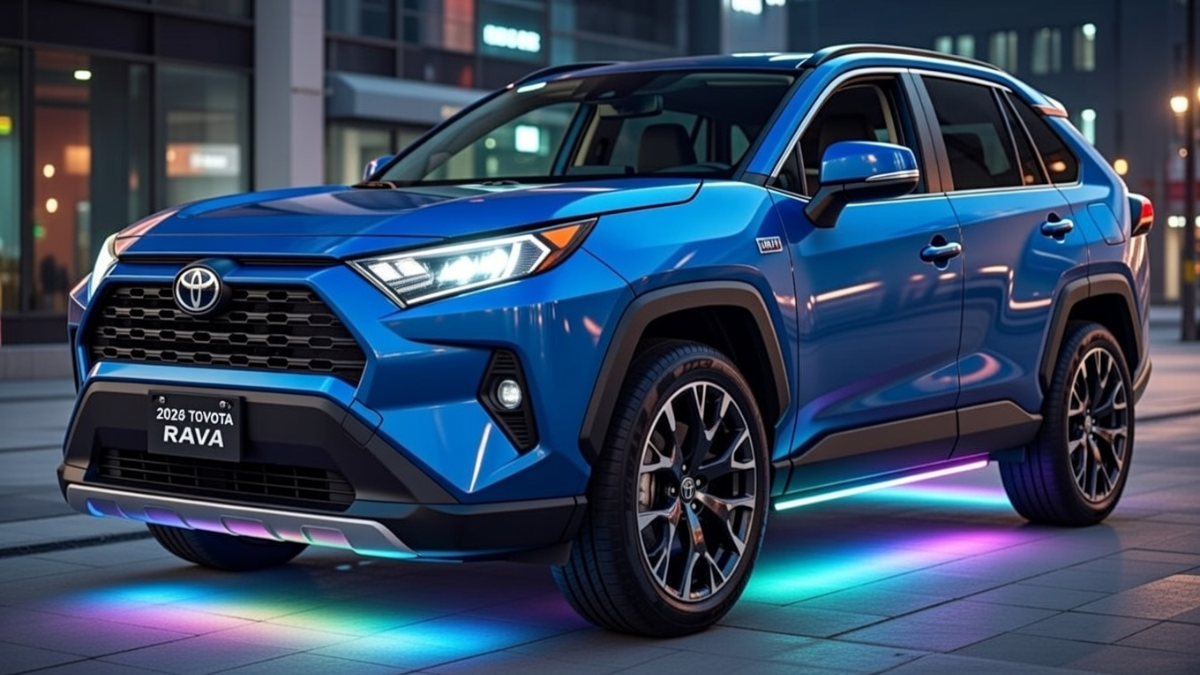
The 2026 Toyota RAV4 arrives at a critical moment for compact SUVs. Once celebrated as the ultimate practical crossover, the RAV4 now faces a new challenge. Rising prices, aggressive styling changes, and increasing tech complexity have led many buyers to ask a blunt question. Is the new RAV4 a smart evolution, or is it drifting toward a $40,000 disaster?
Built on the global success and engineering discipline of Toyota, the 2026 RAV4 attempts to balance innovation with familiarity. Whether it succeeds depends on what buyers truly value in today’s market.
Futuristic Design Signals A Bold Direction Change
The most noticeable change in the 2026 RAV4 is its futuristic design language. Sharper lines, a more angular front fascia, and aggressive lighting elements give the SUV a more tech-forward appearance. This design clearly aims to attract younger buyers and compete visually with newer electric-inspired crossovers.
However, not everyone welcomes this shift. Some longtime RAV4 fans preferred the understated and rugged simplicity of earlier generations. The new look is eye-catching, but it also risks aging faster as design trends evolve.
The question becomes whether bold styling adds lasting value or short-term excitement.
Interior Technology Takes Center Stage
Inside, the 2026 RAV4 leans heavily into digital modernization. Larger screens, expanded driver displays, and deeper software integration redefine the cabin experience. Controls are more centralized, and physical buttons are reduced in favor of touch-based interfaces.
For tech-focused drivers, this feels like a major upgrade. For others, it raises concerns about usability, long-term reliability, and repair costs. As technology ages faster than mechanical components, buyers worry about how well these systems will hold up over time.
More tech does not always mean better ownership.
Performance Focused On Efficiency Over Excitement
The 2026 RAV4 continues to prioritize efficiency rather than performance thrills. Power delivery is smooth, predictable, and tuned for daily usability. Acceleration feels adequate but not inspiring, reinforcing the RAV4’s role as a practical family vehicle rather than a sporty SUV.
Hybrid options remain a major strength, offering strong fuel economy and lower running costs. For commuters and families, this efficiency-first approach makes sense. For buyers expecting a more engaging drive at higher prices, it may feel underwhelming.
The RAV4 plays it safe, intentionally.
The $40,000 Price Line Changes Everything
The biggest controversy surrounding the 2026 Toyota RAV4 is pricing. Well-equipped trims are now approaching or crossing the $40,000 mark. At this level, buyers begin comparing the RAV4 not just to compact SUVs, but to entry-level luxury models.
This is where expectations change. Buyers expect quieter cabins, premium materials, stronger performance, and a more refined experience. While the RAV4 delivers reliability and efficiency, it may struggle to emotionally justify its price against more upscale alternatives.
Value perception becomes the deciding factor.
Reliability And Resale Still Work In Its Favor
Despite the concerns, Toyota’s reputation for reliability remains a powerful advantage. Historically, RAV4 models have delivered strong resale value and predictable ownership costs. This matters greatly in an era where long-term affordability is becoming more important than brand image.
Even at higher prices, many buyers trust the RAV4 to cost less over time than competitors that offer more features but higher maintenance risks.
Trust is a form of value that does not show up on spec sheets.
Who The 2026 RAV4 Makes Sense For
The new RAV4 is ideal for buyers who prioritize efficiency, safety, and long-term reliability over performance or luxury branding. Families, commuters, and conservative buyers will appreciate its balanced nature.
However, shoppers seeking excitement, premium feel, or strong emotional appeal may feel conflicted at higher trims. For them, the price raises questions that the RAV4 does not fully answer.
It fits logic better than passion.
Futuristic Upgrade Or Overpriced Evolution
The truth lies somewhere in between. The 2026 Toyota RAV4 is not a disaster, but it is no longer the obvious bargain it once was. Its futuristic design and tech upgrades push it forward, while rising prices push it into uncomfortable territory.
For buyers who understand what they are paying for reliability, efficiency, and predictability the RAV4 still makes sense. For those expecting luxury or excitement at $40,000, disappointment is possible.
Conclusion
The 2026 Toyota RAV4 represents a turning point rather than a failure. It is a smarter, more advanced SUV that reflects modern trends, but its rising price forces buyers to think harder before committing. Whether it feels like futuristic progress or a $40,000 mistake depends entirely on expectations. The RAV4 remains a logical choice, but it is no longer an automatic one.
Disclaimer: This article is based on early market expectations, pricing trends, and industry analysis. Final specifications, features, and prices may vary by region and trim level.